
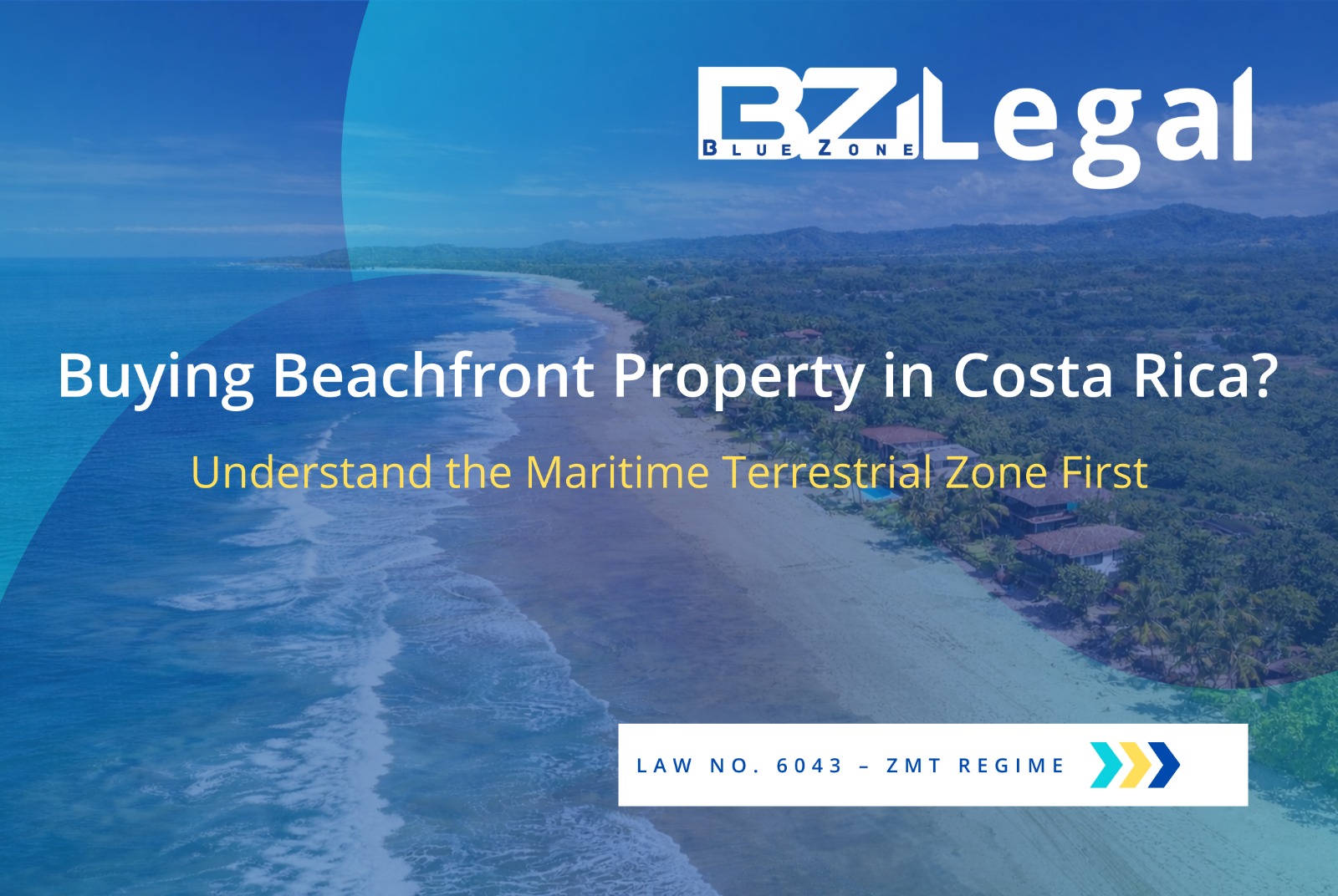
A Practical Guide to Beachfront Property, Concessions, and Coastal Ownership Rules in Costa Rica
For many foreign buyers, owning property near the beach in Costa Rica is a dream. However, purchasing coastal land here is not the same as buying beachfront property in the United States, Canada, or Europe.
In Costa Rica, the first 200 meters from the high-tide line are governed by a special legal regime known as the Maritime Terrestrial Zone (Zona Marítimo Terrestre – ZMT), regulated primarily by Law No. 6043.
Understanding how this system works is essential before investing in any coastal property.
What Is the Maritime Terrestrial Zone?
The Maritime Terrestrial Zone consists of a 200-meter strip of land measured inland from the ordinary high-tide line (pleamar ordinaria).
It is divided into two legally distinct sections:
1️⃣ The Public Zone (First 50 Meters)
- Extends 50 meters from the high-tide line.
- Is inalienable and cannot be privately owned.
- Must remain for public use.
- Guarantees free access to the beach.
- Does not allow private residential or commercial construction. Any exceptions are strictly limited, temporary in nature, and only permitted for specific public-interest infrastructure authorized by law.
No individual or corporation can legally own this portion — it belongs to the State.
2️⃣ The Restricted Zone (Next 150 Meters)
- Covers the following 150 meters inland.
- Cannot be privately owned in fee simple.
- Can only be used under a municipal concession.
This means buyers do not acquire traditional ownership. Instead, they acquire a concession right, granted by the local municipality and subject to approval by national authorities such as the Costa Rican Tourism Institute (ICT).
The land remains part of the public domain, and its use is always subject to regulation and public interest considerations.
What Is a Concession?
A concession is:
- Granted by the municipality.
- Typically valid for 5 to 20 years.
- Renewable if obligations are met.
- Subject to payment of an annual canon (similar to a government lease fee).
- Revocable in case of non-compliance.
Important considerations:
- Concessions cannot be freely transferred without municipal approval.
- Foreign individuals who have not legally resided in Costa Rica for at least five years cannot directly hold a concession in their personal capacity. However, they may participate through a Costa Rican corporation, provided that at least 51% of the company’s equity is owned by a Costa Rican citizen, in accordance with the applicable legal requirements.
- Certain corporate structures (for example, bearer share companies) are not eligible.
- The concession must align with the approved coastal regulatory plan (plan regulador costero).
This is why proper legal structuring is critical when acquiring concession property.
Not All Coastal Property Is ZMT
There are important exceptions.
Some coastal areas classified as “Zona Urbana Litoral” may fall outside the ZMT regime if:
- They were historically consolidated urban areas, and
- They have been formally declared as such by the competent authorities.
Additionally, some coastal properties may be fully titled if they were validly registered under specific historical legal frameworks.
Each property must be analyzed individually. Assumptions are risky.
Why Due Diligence Is Essential
In recent years, certain high-demand areas — including parts of Guanacaste — have faced increased scrutiny due to:
- Lack of proper demarcation of the public zone.
- Absence of approved regulatory plans.
- Registry and cadastral inconsistencies.
- Environmental protection overlaps.
- Irregular or expired concessions.
Administrative warnings, construction restrictions, and even demolition orders are not theoretical risks — they can occur if the property does not comply with ZMT regulations.
Before buying coastal property, you must verify:
- Whether the land is located within the 200-meter ZMT.
- Whether it is in the public or restricted zone.
- Whether a valid concession exists.
- The concession’s expiration date and renewal status.
- Whether it is transferable.
- Whether the municipality has an approved coastal regulatory plan.
- Whether the construction matches the approved use.
Common Mistakes Foreign Buyers Make
✔ Assuming beachfront land can be fully owned.
✔ Not reviewing concession terms and expiration.
✔ Ignoring zoning and environmental limitations.
✔ Buying improvements built without proper permits.
✔ Failing to confirm official demarcation by the National Geographic Institute (IGN).
The Bottom Line
Costa Rica’s Maritime Terrestrial Zone is not a loophole — it reflects the country’s commitment to environmental protection, sustainable tourism, and public access to its beaches.
Beachfront investment is possible — and can be very successful — but it requires:
- A clear understanding of the concession regime,
- Proper structuring,
- Careful legal due diligence,
- And coordination with municipal and national authorities.
Coastal property can be one of the most rewarding investments in Costa Rica — when approached correctly.
The key is understanding the legal framework before committing.
We help local and international clients evaluate risk, verify concession status, review zoning compliance, and structure acquisitions properly from day one.
If you are exploring a beachfront opportunity, let’s discuss it before you sign.
📬 Reach out to our team and protect your investment.
© 2026 Blue Zone Legal®. All rights reserved.
The information contained in this blog is provided for informational purposes only and does not constitute legal advice, nor does it create an attorney-client relationship. Readers should not act upon this information without seeking appropriate professional counsel.
Quotations of this content may be used provided that proper credit is given to Blue Zone Legal and a direct link to the original publication is included.






Leave A Comment